Showing posts with label home school. Show all posts

Tuesday, July 29, 2014

Ships and Sailing

Ships and Sailing the Seas

Having a decent introductory knowledge of sailing vessels is useful for any history studies of the age of discovery and exploration as well as for many of the wars fought between empires even as far back as the wars between Greece and Persia.  Since I am expecting to cover this period in World History with Alice this year it seemed appropriate to have a page with resources about Ships and Sailing.  Additionally, there are plenty of tie-ins with both science and literature.  Besides, with a father that loves ships, sailing and related literature, it is a topic I have bumped up against but really know very little about myself and I wanted to learn more (one of my favorite advantages of homeschooling is how much I get to learn in the process of preparing to teach and teaching Alice).  I hope you will find this resource list useful in whatever it is you are studying with your kids.


Useful Movies:

NOVA; a History of Navigation


PBS Series: Warships has four episodes each about a different era of warships.  The series is really more of a focus on battle technology as it relates to sea battles.  The first, Sea Power is the one that includes sailing vessels but is by no means chronological or complete in terms of coverage of earliest sailing vessels.   

Sailing Across the Atlantic is one I am super glad I found before beginning the school year because it will be a great complement when we study the Vikings.  The crew approximately traces the path of Eric the Red from Greenland to Newfoundland during the first leg of their journey.  The ship is much more modern - being only 80 years - as is a great deal of the technology the crew uses, but the voyage still shows clearly what it is like navigating these waters by sail.  Evidence of global warming also comes up - so if you are doing any studies related to this topic, it may be a good cross-over as well.


Book Resources:

Information and Relevant Picture Books:

The visual Dictionaries and Encyclopedias done by DK publishers are reliably good resources to have around for your kids.  The visual elements are stunning, layouts non-threatening, and text concise and easily understandable, so it is no surprise the Visual Diction of Ships and Sailing would top my list for non-fiction resources I wanted to be sure to have on hand for Alice.  The book certainly isn't a complete resource for understanding every sailing term your child might encounter while reading, but it is a great place to start and will cover most of your needs alone.  I found it to be the perfect amount of information needed at our finger tips.  When an answer wasn't available in this book, a perusal of a dictionary  or Wikipedia usually did the trick.

The Amazing Book of of Paper Boats:  This book has basic information about the science behind boats and has 18 boats to create from different points in nautical history.  It goes over water displacement, density and buoyancy, and stability as well as the historical development of boats and boating.  The paper constructions are beautiful and a fun activity for patient hands - I would not use it with the very young as a general rule.  Even with an elementary student, I suggest an adult do the scoring and cutting portions as prep.  Time required for each project is listed in the instructions and is usually listed at around two to three hours.  The two I have completed took less time actually working on the boat but using glue meant the over-all time was longer because we had to stop and wait for the glue to dry.   Once complete, the paper boats are amazing.  The paddles on the paddlewheel even turn!!  This book doesn't seem to be available new anymore.  However, it does seem to be readily available in new condition in the used sections when looking for books online.  It seems many people have purchased it, thinking it looked cool and then never completed the constructions.

Language Arts Options: 

The Boy who Sailed Around the World Alone
An autobiographical description of a modern sailing journey made by a teenage boy passionate about sailing.  While this voyage takes place well after a time when sail power was the only boating option for voyages that crossed the sea,  kids get a view of how an activity from so long ago is still practiced in today's world.   The fact that it is a true story of a young man sailing around the world might make it especially interesting to a middle-school or high-school student that is not generally keen on reading otherwise, but likes sailing and boats.  I haven't seen this, but there was even a movie made! The Dove.

Treasure Island
Who hasn't at least heard of this classic?  Robert Louis Stevenson's classic tale of a boy who is swept up into an adventure seeking treasure has been re-written and parodied in all forms of media since the late 1800's when it was first published.  Alice is reading this one with her grandfather as I type this line.  She has already seen Treasure Planet, but we'll make sure to order at least one of the movies to watch as well.  1950 Movie, 1934 Movie, Muppet Treasure Island (1996), I'll have to preview Sky1's TV Miniseries of Treasure Island but I'm amazed at the cast involved and look forward to doing so (The Making Of Video).

The True Confessions of Charlotte Doyle
I have not yet read this one myself, or with Alice, but I know it has been met with enthusiasm by educators and readers from many walks of life.  I know Charlotte Doyle is independent, rebellious, and the novel addresses civil rights (for all) within its themes.

Unfortunately, I just haven't read a lot in this area of literature so, as I expand my sailing novel experience, I'll offer this Goodreads list as it has a much more exhaustive list with a range of reading levels and various age-appropriate choices than I can offer at the moment. 


Games, Printables and other Online Resources:

Old Bristol Historical Pages are ones I intend to look into more deeply and use more as I prep for the Caroline History Unit.  At first glance, it looks like a wonderful resource.  I link it here mainly for the diagram of a British Man of War.

School of Sailing - Sailing Terminology

Which Boats are What? - Wikipedia list of vessel types and distinctions

Sea Chanteys Lesson Plan on Age of Sail

How to Tie Boating Knots - animated knot tying instructions

Try Engineering: Sail Away Lesson Plans design and engineer a watercraft

eGFI - Math and Design in Sailing Vessels - another lesson plan focusing on designing a sailing vessel.

Sail Power - Make a sailing vessel with move-able sail so your kids can see how the boat moves relative to the direction of the wind


Field Trip Ideas:

I believe hands-on experience is the most memorable form of learning, so whenever possible I go on "adventures" with Alice that relate (however loosely) to things she is, or will learn.  We recently enjoyed an evening cruise on the Spike Africa thanks to a dear friend (yelp reviews).  The Spike Africa welcomes persons that require the use of a wheelchair - something I know not all vessel programs can, or will do.  Alice had a fun evening and an introductory experience with sailing to which we will be able to refer back. I don't think she'll ever forget hearing the command, "Block your sweats" called out to the crew when the mainsail had just been hoisted (I know I'll never forget her reaction) and she was even allowed to captain the ship for a period during the voyage.


In looking for other opportunities, I found a few companies that seemed to offer a true sailing experience.  As much as some of these experiences look like a true adventure (and one that would be life-changing) they are not in the cards for my little family at this time.  However, some of these resources may be helpful to you (and I hope, something we might come back to down the road).  If you go on one of these voyages or charter through one of these companies, please stop back and add a comment sharing your experience:


Black Dog Tall Ships looks like a GREAT program for elementary/middle school kids. If you, or your kids have been involved in this experience please add a comment and inform future readers about your take on the program.  It appears they also charter similar to Schooners Northwest's Spike Africa and offer summer camps.

Age of Sail offers day camp experiences as well as overnight encampments based out of San Francisco for groups such as classes, scouting troops and similar programs, and has a summer camp offering as well.

For older "kids"
List on Squidoo
Sail Training International

Tuesday, December 4, 2012

Bookshelf Markers for Organization

We actually use bookshelf markers!  I know it is a little anal, but it sure does help us keep track of all our books and where they belong.
To make these, I obtained a bunch of paint stir sticks.  Each member of the family got a color and I painted the sticks and then used Permanent marker to create my stick figures representing each of us.  Each family member got two markers.  Plus, we made a few more for "school books" since we homeschool. 

The idea is that one marker goes in the book shelf when a book is removed to save the place where that book belongs.  If an individual in the family doesn't have a free marker, that means there is a book laying around the house that needs picking up in order for another book to be removed from the shelf.

You could decorate the stir sticks anyway you pleased (as you can see from mine, no artistic ability is truly required).  Hope you find this idea useful.

Saturday, October 20, 2012

First Grade Reading List

First grade is usually a big year for gaining reading independence for kids.  If you are looking for a great selection of easy reader books or ideas about programs to help your child learn to read, please check out "A note on Beginning Readers".  This article is simply the list of books we used with her First Grade Curricula and decisions were often made based more on how the books would play with other topics she was studying or for literary concepts like character, problem and solution, cause and effect and plot concepts.  For example, "Just Lost" by Gina and Mercer Mayer was chosen as a way to go over safe decisions if she gets separated from adults in public situations and "Fancy Nancy Poison Ivy Expert" was my way of introducing her to how to watch out for this pernicious plant when we are in the woods.  Both books happen to also come from a list of books that are pretty easy to read.  Harry and the Lady Next Door is great for picking out problem and solution and all the books from Zonder Kidz related to our study of the development of the first Hebrew cities and culture as a part of ancient History.

Books Alice Read to Us:

From Zonder Kidz: I Can Read - 

Jonah and the Big Fish
Daniel and the Lions 
David and the Giant

I Can Read Books:

Bath Time for Biscuit; Alyssa Satin Capucilli
Biscuit's Day at the Farm; Alyssa Satin Capucilli
Amelia Bedelia Helps Out; Peggy Parish
Little Bear; Else Holmelund Minark
No Fighting, No Biting; Else Holmelund Minark
Owl at Home; Aarnold Lobel

Step Into Reading:

Old, New, Red, Blue; Disney
Tangled, A Horse and a Hero; Disney
Unicorn Wings; Mallory Loehr

Scholastic: 

I Spy Books
Annie and Snowball and the Dress-up Birthday; Cynthis Rylant

National Geographic Kids

Sea Turtles
Dolphins

Misc.

Go Dog Go
And I mean it Stanley
Bedtime for Francis
Danny and the Dinosaur
Various Curious George Books
The Legend of the Blue Bonnet
Who Will be My Friends
Frog and Toad are Friends
Harold's Purple Crayon
Most of the Berensstein Bears Collection
A number of Jonathan London's Froggy Books
All of the Elephant and Piggie Books and Cat the Cat by Mo Willems
Big Red Barn
Runaway Bunny
Harry and the Lady Next Door
If you Give a Cat a Cupcake
If you Give a Pig a Pancake
If you Give a Moose a Muffin
One Fish, Two Fish
Hop on Pop


Books We Read Together, Or I Read to Her:

All in Just One Cookie
The Great Kapok Tree
The Shaman's apprentice
My Backyard Garden
Garbage Helps Our Garden Grow
Soil an Early Bird Book by Sally Walker
The Tiny Seed
A Seed is Sleepy
Watch a Seed Grow
Classical Myths to Read Aloud
26 letters and 99 cents
That Rabbit Belongs to Emily Brown
Charlotte's Web
Charlie and the Chocolate Factory
Mr. Popper's Penguins
I Once was a Monkey
Stuart Little
The Sneeches
What Was I so Afraid of?
Lights for Gita
Tales of Amanda Pig
Little Oh
Thumbelina
The Sugar Child
The Gingerbread Man
The Stinky Cheese Man
The Three Little Pigs
The Three Horrid Pigs
The Three Little Javelinas
The True Story of the Three Little Pigs

Collections We Love:

The Miniature World of Peter Rabbit
The Nutshell Library 
Treasury of Fairy Tales (Naomi Lewis)
Aesop's Fables
Jim Weiss and a variety of his Audio Collections including Myths of Ancient Greece, Stories of the Bible and Shakespeare for Children.
The Starbright Foundation's Fairy Tale Classics

Monday, October 1, 2012

The Halloween Graph


Make a graph out of your Halloween Treats and Learn something in the process.  Activity is aimed at early elementary

1.  Create a grid on a poster board where the squares are fairly large (these are two by two cm - see photo).

2.  Pull out any treats that are particularly large and won't work for the activity.  Set those aside.


3.  Have your child help you "sort" your candies and place them on the grid so that each candy only uses one sqaure (in at least one of the directions)  - See photo

4.  Have your child think about what the graph represents by comparing the "results" of their study.

5.  Let your child eat one or two of their "treats".

Learning advantages:  
Sorting Practice - how will you sort yours?  By brand?  By type?  By flavor?  Nuts, vs no nuts? Fruit flavor?  Hard vs. Chewy?
Introductions to Graphs and Pictoral Representation of Numbers
Comparing and Contrasting Practice.


Originally Published on "Homework Club" Site 2010

Friday, September 14, 2012

Using the Elections in your Curriculum

I usually like to have done activities - or at least most - of the activities I write about BEFORE I publish them.  Nevertheless, like with the Olympics, I find myself realizing that anything I write AFTER the fact won't be helpful again any time soon.  So, I have included some links to other blogs by people with some experience teaching THIS current event to their kids/students and included some of the objectives I have for Alice in this final month + of campaigning.

A few things to keep in mind:  especially with young kids, but ALSO with your adolescents and teens, everything you do is a model for them.  If you want your kids to learn that voting is important and to be informed voters when they vote, you must treat it as though it is important.  Even if you are a staunch conservative or liberal that always votes with the party (even if you do so because you are already fairly informed and "everyone from the other party is an idiot anyway") go through the process as though you are brand new to it.  Do this, while modeling respectful behavior toward others.  Become informed again WITH your kids.  Search for some salient points made by the other party (because really they do make them - can you tell I'm somewhat moderate?)  Read news articles together, watch the debates together and discuss them afterward (Try, during these discussions to listen FIRST, paraphrase what your child has said non-judgementaly, ask if you understood correctly and THEN offer up your thoughts - you are modeling how to be a considerate and respectful model citizen after all).  I know it means a late night, but why not watch the coverage (or at least part of it) the night of the election or watch clips the next morning together?

For an example of the kinds of discussion that can come up when everyone - including the kids - has a chance to speak and be truly heard check out this WONDERFUL example of a good discussion with kids about rights vs. respect that arose out of news from the campaign.

Objectives I Have for Alice I Plan to Teach Using the Election:

Objectives usually  begin with a verb.  They are active.  Something a student should be able to do after the lesson or series of lessons you are giving. So, if you need to turn these into complete sentences, preface each with "the learner will be able to".
  • Describe what the President's job description actually is.
  • Use a table.  We will chart each candidate's position on different issues Alice can relate to.
  • Use a Venn Diagram to compare.  Alice will put herself in one circle and a candidate in another.  Where they agree is where the overlap is in the middle.  She will do this for each of the candidates and decide which candidate (based on the issues she looks at) she has most in common with this way.
  • Describe (at an age appropriate level) the elections process and how it relates to democracy.
  • Define what voting is and include steps to voting informatively within the definition.
  • Discuss (at an age appropriate level) parallels between the Roman Republic and The United States.
  • Observe and participate in research.
  • Observe the elections process.
As I'm sure you can see there are A LOT of possible objectives I'm leaving off this list.  We do have a prescribed curriculum to do as well (both an advantage AND a disadvantage of virtual schooling) AND she is only six.  However, there are other things you could do with older kids, or if you were freer to spend an entire month or two doing almost nothing else. 

Other Objectives I will have During Future Elections (Presidential or not):

Math:

  • Use polls to observe statistics in action. 
  • Analyze "spin" on an issue using the statistics presented by each side to illustrate how that side perceives the problem and solution.  See how both sides can "tell the truth" or use accurate numbers but make it look like two very different stories.
  • Calculate percentages (democratic votes/number of voters in a precinct, percentage of electoral votes for each state. . .)
  • Use different types of graphs appropriate to the data set.  (Pick one set of statistics about an issue and graph the numbers as many ways as possible.  Do bar graphs, line graphs, pie charts. . . Then, look through newspapers to find trends in which types of graphs are most often used for what kinds of data.  Discuss why certain types of graphs work better in certain situations).
  • Time and Score debates.

Humanities:

  • Watch history in action. 
  • Make Word Clouds related to the vocabulary of elections
  • Use journalistic writing.  (Read and discuss multiple news articles about the election.  Compare news articles with editorials.  Then have them view a speech or debate and write their own articles about it.  Each child writes an editorial AND a news article.  Then, for the next item have them analyze their own articles for bias and rewrite attempting to remove the bias)
  • Analyze media for bias.  (Read and discuss multiple news articles about the election and seek out signs that show what the journalist thinks.  Then, have them view a speech or debate and write their own articles about it.  Each child writes one editorial and one article that attempts NOT to show their viewpoint)
  • Use persuasive writing (each child writes a persuasive article to convince you and others to vote for that child's favored candidate.)
  • Write a letter.  (Write letters to the candidates - ask questions, persuade each to care about a particular issue and the child's solution. . .)
  • Analyze speeches made.  (Analyze diction, dynamics AND the content of the speech.  Pick out the introduction, body and conclusion.  Compare styles. . . If they were campaigning, what would your kids say?  Have them write, edit, practice and perform their speeches.  If you don't have an audience nearby, use a camera and broadcast to family members)
  • Every time the kids are writing there are opportunities for learning grammar, usage and mechanics that will arise through editing.  Don't forget to have them edit!
Many schools have mock elections.  While this is difficult to do in a meaningful way in a single home, perhaps your network of friends, your cooperative, or other support group can all get together to work out a mock election for your kids to participate.  Such a thing may seem like a lot of time and hassle for nothing really, but it does motivate mid and upper elementary students to take the research part of their voting more seriously.  They really do become a lot more connected to it when they get to vote (even if their vote doesn't count in the real thing yet).  If you have a way to put one together - do it.  Make a party out of it and then have your election finish in the afternoon on election day and follow the election night news coverage together.  What a great way to show your kids how important this process is and make it memorable.

Resources for Activities:

Teacher Vision - Lots of Links and Resources specific to the election AND lesson plan ideas.
Education World - Using Editorial Cartoons during the elections and campaign season.
Busy Teacher's Cafe - Links for Elementary lessons and activities.
Homeschooling Election Freebies - Links to free resources to help in teaching about the election process.

Wednesday, August 15, 2012

My Shadow


My Shadow
I have a little shadow that goes in and out with me,
and what can be the use of him is more than I can see.
He is very, very like me from the heels up to the head;
and I see him jump before me, when I jump into my bed.

The funniest thing about him is the way he likes to grow-
not at all like proper children, which is always very slow;
For he sometimes shoots up taller like an india-rubber ball,
and he sometimes gets so little that there's none of him at all.

He hasn't got a notion of how children ought to play,
and can only make a fool of me in every sort of way.
He stays so close beside me, he's a coward you can see;
I'd think shame to stick to nursie as that shadow sticks to me.

One morning, very early, before the sun was up,
I rose and found the shining dew on every buttercup;
But my lazy little shadow, like an arrant sleepy-head,
Had stayed at home behind me and was fast asleep in bed.

-Robert Louis Stevenson

During a sunny saturday prepare to take your child outside a couple of times with a tape measure and sidewalk chalk.  Sometime in the morning when the sun is still low have your child stand still as a statue and trace his/her feet tightly and then the perimeter of his/her shadow.  Your child can do the same for you.  Go back out at noon and in a spot near to the first set of chalk-marks, do the same thing again.  Repeat this again at about 3:00 and then again in the evening not long before bed (or sunset whichever is most appropriate)

Things to do with the information - same night or next day:

Measure the lengths of the shadows together and record them in a notebook.  

Create a graph showing the lengths of the shadows on the y axis and the time of day on the x axis.

Discuss the angle of the sun as a possible cause for the changes in your shadows and then test the hypothesis in a dark room using a flashlight and something tall (a shampoo bottle, opaque glass . . .) see if the effect can be recreated.

Bonus Activity:  After it is evident your child understands that a shadow changes depending on the angle of the light hitting it, you might try learning about, and then making your own sundial.

For information regarding how they work and the history of sundials try: http://www.fi.edu/time/Journey/Sundials/aboutsd.htm

Materials:
Long Stick/Stake
Mallet, hammer or other item (large rock) to pound it into the ground.
Sunny Day

Use a long stake and drive it into the ground so that it points at the sun. (in other words, unless it is noon it should not be straight up and down).   The stick should not make much of a shadow right away.  Wait about an hour until a distinct shadow has appeared that is about 6 inches long.  Mark this point according to what time it is and then continue to mark the shadow every hour.  This sundial will now work approximately for a few days.  However, the angle of the sun varies over the course of the year so it will not remain accurate perpetually.  To make a more permanent sundial is much more complex.  If you have an interested kid and would like to try it though, here is a website that lays out the details for building a portable sundial.  This is a teacher to students about sundial making as an assignment.

Definitely for your highschooler.
http://www.fi.edu/time/Journey/Sundials/aboutsd.htm

Friday, July 20, 2012

There are Really Only a Few Essentials

It is really easy to get caught up in developing "the perfect classroom" and wanting to have this wonderful space full of beautiful educational items for your child to "enjoy" (That all cost a pretty penny).  There are also a lot of companies out there that want you to believe their stuff is the best, but really there are only a few items you MUST own to successfully teach your kids at home other than shelter and food that is.
  1. The usual supplies you would need to send them to a mortar and brick school anyway: a few organizational items like folders and notebooks and something to write with and something to write on.  Having a white board and markers is great. You use less paper when you use it and its easy to erase, but paper and pencil works well too and then you have a record of the work your child has done.
  2. A World Map and or Globe:  Once you have one hanging up in a convenient spot in your home (hopefully near where you do most of your lessons) you'll be amazed at how often it gets referenced.  The key is making sure it is convenient.  If its a map, don't roll it up and keep it somewhere - it really is important to have it hanging up and available.
  3. A library card:  There simply is not a better way to have access to hundreds and hundreds of resources for you and your child.  Aside from books, libraries offer music, movies, activities and their librarians.  Wonderful resources in and of themselves that are severely under-used in most cases - they have quite an education and can offer up sound advice about reference tools (on and offline) as well as how to navigate their spaces, how to get involved in local book and writing clubs and your children's librarian can probably offer some of the best ideas about fabulous books to read with your child for almost any occasion.
  4. A journal:  Whether you keep your journal on your computer, in a tablet, a special book or in a public blog online, you'll need a record of the lessons you complete with your child and sample work he or she has done for state requirements (which vary from state to state) and to help you successfully comply with school attendance regulations.
  5. A computer and Internet hook-up: This provides you another window to the world.  Many of the educational videos we watch are accessed online.  A great number of resources I have used were found and accessed online.  The world language program we use is a series of videos and computer games,  There are online dictionaries, thesauri and a world of information - just make sure you know the basics about distinguishing between reliable information and that which is not and teach your kid those basics along with safety guidelines regarding Internet use.
  6. A Stopwatch:  I know, this one may surprise you, but there are quite a few times in science and PE when you find a stopwatch necessary.  Also, setting a child against the clock to clean up, practice and hone a skill like addition, or finding things on that world map is a surprisingly frequent aspect of schooling.
  7. Desire: A desire to learn, connect and be with your child through the great days and the fabulous days as well as the dismal ones.
  8. Creativity: Especially on those dismal days, you may find thinking outside the box a huge help, but when your lessons are also "outside the box" - or at least seem so to your kids - everyone has more fun.
  9. Time: It takes a lot of time to home school, research, prepare, etc. are all a part of your day in addition to the time you actually spend with your child.
  10. Patience and Perseverance: Learning is a process, not a destination.  Patience and diligence through the tough parts of that process are essential.
Anything else is gravy!  I have a lot of gravy, but its still just gravy.  Note the Parents Spending Portion on the chart to the right, be heartened and remember how little the difference in result is between a higher portion of spending and a lower portion of spending.


Sunday, May 27, 2012

Assessments of Wiggle Worms

It is really easy to forget that the definition of the word assessment really does not say that a formal "test" with paper and pencil is required.  Even educationally related definitions of the word simply state that is an evaluation of a student's achievement on a course. 

There are many way's to evaluate a child's understanding of material that has been covered in lessons or activities over their course of study.  While testing skills do become important, not every assessment of a child's abilities or understanding needs to be administered in a way that requires sitting still and writing it all down.  Such forms of assessment require reading and writing skills that may not actually be related to the objectives of the assessment and therefore may not give the most genuine idea of the student's abilities anyway.

Dramatic Assessment: 
Why not have your child "act out" their understanding?  Is she or he supposed to show that he or she followed and understood the main ideas and chronology of a story you just finished reading?  Show an understanding of the main events that led to a culminating event in history and the main characters involved in those events?  Is it a scientific cycle that is supposed to have been understood?  Have your child design appropriate costumes, puppets, or felt characters and act out the main events while narrating the story or cycle instead of having to write about it, or answer a bunch of questions about it.  Don't forget about the option of using Dance as a form of expression in this type of assessment as well.  Have your child explaining what the movements represent as he or she dances them.

Conduct an Interview:
Record an interview in which your child acts as one of the main characters in the historical event or story, or as a scientist explaining an important cycle to the general populace (maybe they'd like to imagine themselves a bit like Bill Nye) and you are the reporter.  Ask open-ended questions and see what answers you will get, they will be far more telling in regard to what your child has actually understood than any old multiple choice test would be.

Allow your child to Illustrate:
Perhaps your child would like to write and illustrate a children's book on the subject, or simply make a chart or poster that depicts the information or concepts about which you need to assess understanding.  Many schools have children build dioramas or other types of crafts to depict famous scenes or groups of people.

Sing Lyrics and Play Music:
Maybe you have a budding musician in your household.  Let him or her sing lyrics to you about the subject.  Perhaps the tune will even work to convey ideas.  In a song about the water cycle, maybe the music sounds whispy during the part about evaporation, but plincks and drips when the rain begins falling during precipitation and then floats when the precipitation becomes colder and the precipitation becomes snow.

Whatever you decide to do, mix it up and use different assessment styles at least some of the time.  Traditional paper and pencil assessments have their place, but are not the beginning and end of all evaluation.  Just make sure that whatever type of assessment you'll be using, your child knows exactly what it is that is supposed to be demonstrated up front and ahead of time.

Wednesday, May 23, 2012

A Newly Discovered Fidget

For those of you not already aware of fidgets, all you need to do is check out my article on the subject matter, Teaching Wiggle Worms.

I don't know why this one has never occurred to me before, but it didn't until Alice had a magnet out and a bunch of nuts (you know, the ones that go with bolts - hex nuts).  We've played with them before, but it gave her something to fidget with while she did her other work all day today.  Go figure!

To put together this decorative, desktop fidget, make sure you have a fairly strong magnet, a pincushion magnet would work really well and can be purchased anywhere you would by sewing supplies (but we were just using one from one of her science kits today).  Then, buy a bag of small hex nuts and voila!  Magical sensory stimulation for one hand, while the other does the writing or the ears do the listening.

You might also try other little metallic objects such as paper clips or coins.  Maybe you have some metallic buttons lying around. . .

This also makes for a great activity with sculpture buy the way!  Put it together and you will see what I mean.  Click the link for more ideas on make at home fidgets.

Wednesday, May 16, 2012

Jack o Lantern


A GREAT LEARNING ACTIVITY THAT PRODUCES ITEMS THE WHOLE FAMILY CAN ENJOY!
This article was first published on Facebook in the Fall of 2011.  Here it is for you to access now.

So, we carved our pumpkins today. I was determined to use as much of the left-over bits as possible. Plus, Alice and I have been talking a lot about fruits and veggies lately. We read, "Eating the alphabet" and have been looking for the fruits and veggies listed in it and opportunities to eat them ever since. That was how we discovered Ella likes artichokes. 
There are two foods we eat fairly regularly, that use Pumpkins, pumpkin pie and pumpkin loaf. We made pumpkin pie (Believe it or not, Alice actually made it, though I helped with the crust) last night, and pumpkin loaf this morning. My family always roasted the seeds from the pumpkin we carved and in order to use the scraps from the carving, I also found a recipe for a pumpkin soup. Maybe next year we will really do it right and plant some pumpkins of our own and really take the whole thing from start to finish!

Alice would have absolutely nothing to do with the actual carving though. She grabbed a scraper started to go for it and then said, "no way". When her Daddy walked in the door 5 minutes later she told him, "I don't like that ooey gooey stuff". But she enjoyed hanging out with us while we did the carving anyway.

The Pumpkin loaf was inspired by a recipe we found in a library book called, "The US History Cookbook". However, instead of putting in pecans, we put in what was probably available at Plymouth at the time of the first harvest feast that has since inspired thanksgiving.  "Craneberries" as they were originally called were the pecan replacement. Alice loves craisins so they just made more sense than adding the nuts the recipie called for that she probably would have picked off and not eaten anyway. She liked finding the step we were on in the cookbook and following the numbers as we went along.

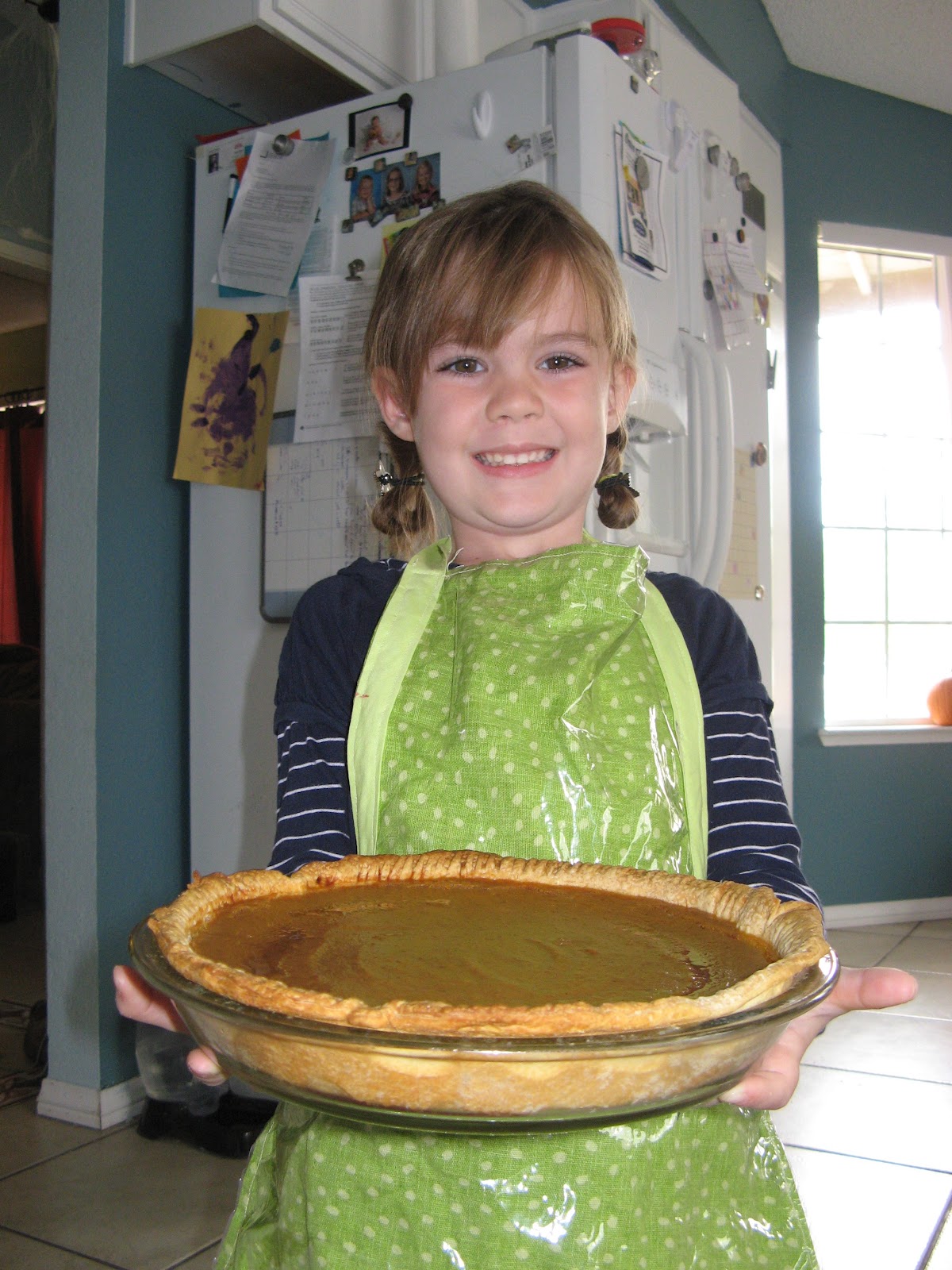
The pie was also made with canned puree and we used the recipe right off the can for that one. Alice measured out all the ingredients and learned how to read fractions while she did so, then she mixed the custard and poured it into the crust I'd gotten ready for her. She had fun doing like the birds on Cinderella, and pressed the crust edge with a fork before we put it in the oven. She's proud of her pie! She said cracking the eggs was the favorite part of making the pie AND the pumpkin loaf.

To make the soup, I sliced three large carrots and and sauteed them with 1 chopped bell pepper. Then, we carved our pumpkins and put all the stringy stuff as well as the tops of the carrots in a pot of boiling water (about 2 cups for every cup of pumpkin stuff) and let it simmer while we carved out the faces of the pumpkins. When that was done, we strained the veggie stuff from the water, and added a little salt, pepper and oregano. We roasted the bits of pumpkin from the faces in a dish in the oven and then put the carrots and pepper mixture, the roasted pumpkin, and some of our pumpkin broth into the blender and blended until smooth. I added milk to cool it down a little (and cream it up). This was our pumpkin soup. I'm sure there are yummier recipes out there, but it worked.  

Meanwhile, the seeds had been separated and put in another pot of boiling water with a 1/4 cup of kosher salt. We let it boil for about 10 minutes and then roasted the seeds in the oven on a cookie sheet once we were done roasting the pumpkin pieces.


We had a GREAT time. Alice learned how to read fractions, measure volumes, plan ahead (she helped write out the supplies and grocery list as well as choose faces for the jack-o-lanterns. In addition, although she decided to forgo the tactile experience of cleaning out the "ooey gooey stuff" she had a sensory experience with the pumpkins and pumpkin purees as well as with tasting the foods afterwards.

Tuesday, May 15, 2012

Make your Own Fidgets

So, it would seem the recent article about Teaching Wiggle Worms was fairly popular.  As a result, I thought you might like some tips on making your own fidgets for your home or classroom.  So here are a few ideas.

These should only be used around kids old enough to know not to chew or suck on such items.  Also be aware of wear and tear as a few might create a bit of a mess if they fall apart.  Lastly, if you multiple children (particularly if they are from multiple families) will have frequent access to these fidgets, make it a part of your weekly routine to thoroughly clean everything in the basket. 

Take two balloons and nest them so that you have a double layer of rubber.  Fill with flour, cornstarch, lavender buds or barley.   Things like popcorn kernels seem like another great idea, but their hard pointy end breaks through the rubber of the balloon.  Tie off both balloons at once.  You can also use surgical gloves (which somehow made them more appealing to kids in the preschool)  The material inside will move around and give an interesting sensation to the fidgeter's fingers while he or she "molds" the object.

Take craft pom poms and glue them together into a larger pile with hot glue.  Some kids might pull this one apart as their fidget, but if it helps them concentrate and learn, oh well.  You've just spent cents and a few minutes to make it so maybe it is a worth while trade-off.

Hand over buttons about the size of a dollar coin with a slightly concave side.  Kids can rub their thumb in the concavity while holding the rest of the button in the palm of their hand.  This works great with polished pebbles as well.

Purchase some remnant fabric in a variety of textures and patch together a few textures, or simply places palm-sized swatches in your fidget basket. 

Add a slinky and a couple of Bendaroos, throw in a clothespin (the kind with springs) and pair of wide (not at all sharp) tweezers or tongs (plastic to minimize noise) for good measure and you have a fairly well rounded box of items.  Reference my article, "Teaching Wiggle Worms" for more fidget ideas as well as ways to work with your "wiggle worm" and get a lot MORE learning done.  Also, for a statement about an outlook on learning that might help an ADD or ADHD student be more successful in academics read both, "Teaching Wiggle Worms" and "What Learning Looks Like to Me".

Saturday, May 5, 2012

How Many Seconds in a Minute? Introducing Preschoolers to Time

How many seconds in a minute?
Sixty, and no more in it.
How many minutes in an hour?
Sixty for sun and shower.
How many hours in a day?
Twenty-four for work and play.
How many days in a week?
Seven both to hear and speak.
How many weeks in a month?
Four, as swift as the moon runn'th.
How many months in a year?
Twelve the almanac makes clear.
How many years in an age?
One hundred says the sage.
How many ages in time?
No one knows the rhyme.
  - Christina G. Rossetti


Children hear things like, "dinner is in twelve minutes" all the time.  This is great for kids as it helps them establish a good sense of time (when the prediction is accurate more often than not).  Increase the frequency with which you give them this "warning" and you not only increase your sanity (they usually transition better when they get such warnings) but you'll increase their sense of time at an earlier age.

Digital clocks are pretty easy to read, but what time it is, usually means very little to most children under four. Even four-year-olds generally don't care about the time unless it relates to a specific activity.  The more regular your schedule, the more meaningful time becomes.  Many toddlers and preschool children are helped by having a poster that shows "times" like, "school time", "meal time", "club time", "bath time"  - etc.  make a visual representation of the things you typically do in a day (or week) and display it in a place where your child will see it a lot.  Then, refer to it when you state the actual time of day, or when you say things like, "bath time is in about 10 minutes - it will be seven-o-clock then".

Play beat the clock for children that are dawdlers.  
Although Dawdling does serve a purpose in a child's brain development, there are times when we just need them to focus and get "it" done.  Set a kitchen timer or other noisy clock ticking to help keep reminding your child he/she has a job to do.  Or, if the job is part of a routine, refer to my article, "Musical Routines".  Challenge him/her to get dressed (or other such task) before the bell rings or the song is over.  A prize can be as simple as, "yeah you did it! great job", a sticker for a sticker chart, or a token for a token jar.  For a more complex reward system where bigger rewards are earned after a certain number of stickers or tokens have been awarded you can actually offer up a cool little prize toy your child will enjoy.  Once your child gets used to this game, he or she might even enjoy learning to set the timer.  The experience of learning to read the correct numbers (even those numbers in the teens) helps to set them up for later when they're learning to count past ten.  When your child is helping you in the kitchen he/she will now also be able to do the job of setting the timer when needed.  The more practice  the better (Also Check Out "Food Math" for other mathematical advantages to having "help" while you cook).

Playing games with kids that involves a "time" element is also a meaningful way of giving your toddler or preschooler a sense of time.  If you are trying to count seconds, clapping your hands and then slapping your thighs (while sitting cross-legged) actually comes pretty close to taking a second for most of us.


Have a Calendar available in a busy room in your house you can refer to with your child.  Put it right next to the poster with your "daily" time chart or poster described above.  Make sure you use both regularly with your child.  Mark the calendar with upcoming important activities and talk about it with your preschooler.  See "Calendar Time: What the Calendar and Holidays . . . " for more information on ways to use the calendar with your kids to teach your kids.  Now that my child is in Kindergarten, I no longer use a daily schedule, but we do have a weekly one.  Check out "Schedule Boards" to see how I use this with Alice and how to make the components so you can have one right on your refrigerator.

Do a Subtraction Scavenger Hunt.


Math Scavenger Hunt
Place a known number of objects (that are the same) out for your child to see and count (choose a number in line with your child's skills, for example if your child easily adds to ten but has a harder time with sums equaling 15, choose 12 objects).  Ask your child to count the objects and then look away.
 imgres.jpg
Remove a number of objects and hide them while your child is not looking.  Ask your child to count the number of remaining objects to figure out how many objects must now be found.  If you started with 12 and there are 5 remaining objects, your child now gets to go find the remaining seven.  Do this once or twice and then move on.  If you make it a habit to play this game a couple of times every few days, your child is getting wonderful practice with subtraction without ever knowing that is what she/he is doing.  To maintain motivation if she/he starts getting bored with the game you could make the objects something he/she likes to collect and they get to be added to the collection once they are found.

Friday, May 4, 2012

Learning about Creepy Crawlies

Creepy Crawlies

You'll find that a lot of children's insect books will mix worms, pill bugs, centipedes, milipedes and arachnids (spiders, mites and scorpions) in with the insects.  Although these are not, in fact "bugs" zoologically speaking, they all certainly fall into the "creepy crawly" category for many of us.  Bugs and their "creepy crawly" companions are incredibly important in our own food production, health and waste decomposition.  Kids that feel an appreciation for bugs and who know which ones are dangerous and which are not will be more comfortable and confident during outdoor activities.  They will also be safer because they will know how to act around insects, arachnids and other small creatures found in the garden.  You can help kids feel less "creepy" about these crawlies by simply learning more about them.  Open their worlds and opportunities by taking a closer look at "bugs".

Once you've done a little research and learned a little about what you might find, there are all kinds of craft projects you can do, including this egg carton craft (if you are a little too creeped out to actually go looking for the real thing) but there are also tons of kits and tools available for study of a specific insect in the home, or for catching, studying and releasing bugs right in your own back-yard.  Have a fun "insect hike" or dig through some compost (wear gloves!) and see what critters you can find there.  You can grow an "ant farm", a "worm ranch" and order lady bugs to protect your roses from aphids.  Please be responsible about making sure any insect (or other creepy crawly) you purchase is a local one before releasing it into the wild and have fun!

Books
Summer Birds, shown at right, is a wonderful book that will tell your child a little bit about mideival beliefs about insects including the belief in spontaneous generation while it also teaches kids about metamorphosis.  The illustrations are brilliant and clear.  I highly reccomend this gem.

Almost any of the visual encyclopedias out there can be wonderful non-fiction "reading" for even the very young.  Examples include Insiders Insects and Spiders, Noel Tait; World of Animals 26: Insects 5, Ken Preston; - Mafham, DK Publishings's "Eye Wonder series" Bugs (DK is Wonderful - check more options out at www.dk.com), or The whole "Minibeasts" Series by Smart Apple Media: Minibeasts In the Compost Heap, Minibeasts In the Home, Minibeasts On a Plant, Minibeasts In a Pond, Minibeasts In the Soil, and Minibeasts Under a Stone.

The entire "Backyard Books" series, Are you a ___________ is also cute, well illustrated and fun.  My three year olds LOVED them when I taught preschool.  Fill in the blank with any of the more popularly known "bugs" such as ant, dragonfly or grasshopper and you have a fun take on that insect's life cycle your child/ren and you can enjoy together.  These books are by Judy Allen and Tudor Humphries and I've mentioned Are You a Ladybug and Are you a Butterfly in other posts as well.

For the particularly young, Eric Carle has a number of books about "Creepy Crawlies"  The most popular is the classic Very Hungry Caterpillar.  However he also did one about a click beetle, a Grouchy ladybug, a Very Busy Spider and a Very Quiet Cricket.  If you include creepy crawlies at the seashore there is also A Home for Hermit Crab and probably others.  Lois Ehlert's Waiting for Wings is wonderful with Whimsical, but illustrative pictures, and finally, Leo Lionni's Inch by Inch is a also a fabulous journey all about crawling inch by inch.

National Geographic Kids Science Fair Winners Series: Bug Science by Karen Romano Young and Illustrated by David Goldin includes insects, arachnids, isopods (rolypolies) and worms.  This book contains great ideas for simple experiments kids can do with and about bugs of different kinds. A bug supply may be required for some experiments.  For the sake of experiments and surveys in the book that require keeping and maintaing bugs, the book includes information about how to catch bugs, raise bugs, keep bugs healthy for a period of time, and all things a person needs to know to keep bugs.  The book also includes a handy guide at the end with tips and suggestions about how to present the experiment as a science fair project if your child will be participating in a science fair. 

Online
All I can say about Insect.org is, you won't believe it till you see it!  AMAZING:  http://www.insects.org/

Insect Lore For fun games and activity ideas relating to insects and Earthworms.  http://www.insectlore.com/

Let's Talk about Insects by the University of Illinois Extension is an animated description of insect basics and vocabulary.  http://urbanext.illinois.edu/insects/01.html

Stein's Virtual Insectory has lots of great photos and  a little information to accompany those photos.  http://www.virtualinsectary.com/

US Geological Survey Biological Resources: Use this one with older kids that might like to go on a bug hike.  Identification tools as well as other entomological information regionally segregated hosted by the Northern Prairie Wildlife Research Center.  http://www.npwrc.usgs.gov/resource/taxa_i.htm

The Bug Club is a website (and club with a published magazine and all) for young amateur entomologists. http://www.amentsoc.org/bug-club/

Teacher's Pages:These sites include a variety of links to websites with lesson plans, crafts or bug-related activities including "tasty" insect recipes.   http://www.teachingheart.net/teachinsects.html and http://iitc.tamu.edu/1998and2000/lesson_plans.html.

Movies
Bill Nye the Science Guy - Spiders:  As usual, Bill Nye's movie offers up humor zaniness and all kinds of entertainment while it also educates.

Eyewitness DVD - This video includes stunning visual images with narration performed by Martin Sheen to help us understand more about what it is we are seeing.

Animal Life in Action - Ansects and other Arthropods

Whatever you do have fun with it, and do your best to be amazed with the cool things these creepy crawlies do rather than creeped - it'll help your child feel more confident outdoors to know that while some things may bite and caution should be used, many "bugs" are perfectly harmless.  Because your child will know the difference between them he or she might even suddenly become more helpful with the outdoor chores. A person can dream can't she? 

Tuesday, May 1, 2012

Commutative Property With Dominos


Domino Math –
One math concept that really helps kids with using math facts quickly is that of the "turn around fact or pair". The concept uses the commutative property which basically says that a+b will always equal b+a.  It is not important that the child know the name of the property, what is important is that she/he encounter examples of it enough to see a pattern and use it to his/her advantage.

For example if the child is very familiar with the result of the commutative property, then if she/he knows that 13 + 8 = 21 then when he/she has to calculate 8 + 13 on a timed test, she/he can speed things up because he/she already knows the answer rather than having to calculate it.  Unfortunately, most kids do not make this connection until much later in school.  Young children usually see math problems as distinct from one another and only begin to understand and use "the rules" for themselves after they've seen the pattern form many times.  They WON'T just take the teacher's word for it.  Many courses teach the concept in one or two lessons, but don't spend enough time with it to make it truly helpful or useful to the elementary mathematician.  

This activity helps kids put a "picture" in their minds of what addition looks like, and makes it a simpler challenge because they are not also concentrating on reading number symbols, or writing number symbols that are probably relatively new. It allows them to concentrate on the concept of addition only.  After they get the hang of the activity shown in the video, it is even easy to turn the whole thing into a game.  If you'd like to do the activity my daughter is doing in the video on this page with your own child here are the instructions for what we are doing:

1. When we started, I pulled out all the dominoes that added up to 10 or less. This way the activity is not overwhelming and remains appropriate for early mathematicians. 

2. My daughter was asked to add the dots from one side to the other side and place the dominoes in piles according to what they add up to in ascending order.

3. While doing the first couple of tiles, I taught my daughter how to "read" the domino in a math sentence - i.e. "2 dots + 3 dots = 5 dots". I then asked her to do the same with some of the dominoes she picked.  We did each domino both ways so she also read "3 dots + 2 dots = 5 dots".  Eventually, they get the idea that it doesn't really matter which number you start with in an addition problem.

4. After she was done sorting we looked at the relationship between how high the number is and the increasing number of ways to "add up to" that number.

5. After knowing she understood she could start with any number she desired I encouraged Alice to "count on" by stating the higher number of dots first and starting her counting from there, "7 + 3" would be counted "seven, eight, nine, ten." As I modeled this for her, she will used this technique more and more. Once your child is confident with his or her facts to ten, go ahead and work on facts to twenty.  Once they are comfortable with this, start giving them a third domino (with no dots on one side).  They then begin adding three addends.  Continue adding challenge this way until they've grown out of the activity and you've replaced it with other methods for practicing math.

By the time we were done with one round of this game, she realized that "0's" add nothing and to check her idea said, "mommy, if I add 0 to 12 is it 12?" She was also asking me about higher numbers plus one that whole afternoon. 

Interest won't last long with this activity because it becomes repetitive even for younger kids fairly quickly. Continue the activity until your child loses interest and then don't push. They are very likely to be interested again another day whereas, if you push, they'll lose interest all-together.  


Once they've gotten the hang of it, you can turn it into a game for more than one player.  


1.  Pull out 20 or more dominos that are appropriately "spotted" for the age and ability of each child.  For example, for a group of Kindergartners, you might use mostly dominoes with one side dotted and the other blank and make sure no sets of dots add to higher than 8 or 12 etc.  For more experienced mathematicians you might skew the domino set to higher numbers and make sure there are not any "zeros".  I do not suggest using the entire box because then the game becomes tedious for all its players and your children will not want to play it.

2.  With your child or children, flip all the dominos over so none of the dots can be seen and mix them up.  Each player pulls a domino and adds both sides together.  Each player must state their domino's identity using two "math sentences" that are accurate (3 dots plus one dot equals four and one dot plus three dots equals four) The person with the domino with the highest sum wins everyone else's dominos.  Play continues until all the dominos are taken from the middle and a winner is established based on who won the most dominos.

When this game is played frequently, those playing are getting a lot of practice with their math facts as well as examples of the commutative property.  If a child is having trouble coming up with a second "math sentence" simply turn the domino around to illustrate the new "problem".  This game is simple and quick enough to be as much fun as Hi Ho Cheerio was when she/he was first learning to count, but more suited for the slightly older child.

Intermediate
Add another level to your domino math practice with dice.  Pull out a selection of 20 or so dominos.  you'll probably want to skew the dominos you pull out toward the higher end of the spectrum of sums you can get from the dominos.  Have your child pull a domino, add the two ends and then roll the die and subtract the amount on the die.  Take turns doing this and when everyone has one domino sum compare.  The person with the highest sum wins all the dominos.  Play until all the dominos are gone and declare a winner based on who collected the most dominos.  Since multiplication is really the addition of sets of numbers, commutative property also works with multiplication so if you have a child working on his/her multiplication tables this can be played using multiplication as well.

If you wanted to add a board game element, you could move a piece around a board game (such as chutes and ladders) instead of "keeping" dominos for scoring. for correct answers they can move forward by the numbers added or just by one.  The winner then becomes whoever gets to the finish first.  Be creative with it and have some fun.